Homework #7 complete by Friday, October 10
1. 24.X.18 (Use the Rayleigh criterion rather than book approximation.)
2. 24.P.42
3. If we were to send a ruby laser beam (wavelength of 694.3 nm) outward from
the barrel of a 2.70-m-diameter telescope, what would be the diameter of the big
red spot when the beam hit the Moon 3.84 x 10⁵km away?
4. Assume the range of pupil variation during adaptation of a normal
eye is from 2 to 7 mm. What is the corresponding range of distances over which the
eye can detect the separation of objects 1 in. apart?
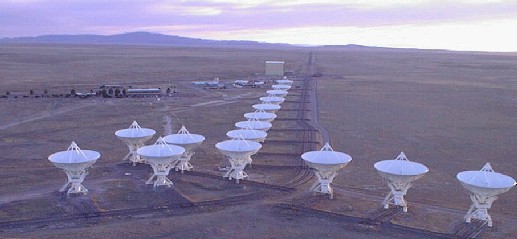
5. The Very Large Array (VLA)
is a set of 27 radio telescope dishes in New Mexico.
Each dish is 25 meters in diameter.
The antennae can be moved apart on railroad tracks, and their combined signals give
the resolving power of a synthetic aperture 36.0 km in diameter.
(a) If the detectors are tuned to a frequency of 1.4 x 10⁹ Hz, what is
the angular resolution of one of the dishes? Of the array of dishes? Convert your
answers from radians to arcsec (1 degree = 60 arcminutes = 3600 arcseconds).
(b) Clouds of hydrogen radiate at this frequency. What must
be the separation of two clouds at the center of the galaxy (26,000 lightyears = 2.5 x
1020 m) if they are to be resolved?
(c) Very Long Baseline Interferometry (VLBI)
is a method of using telescopes
spread across the Earth's surface to observe objects at high resolution. Part of
this network is located across the United States. See this link for a map of sites. Called
the Very Long Baseline Array (
VLBA) , it consists of 10 telescopes of 25-m-diameter.
Such a network allows angular resolutions of better than a milli-arcsecond.
Using this resolution, what is the minimum separation of two clouds at
the
center of the galaxy for them to be resolved by the VLBA? To get a
better sense of this distance, convert your answer to units of
astronomical units, the Sun-Earth distance, where 1 A.U. = 1.5 x 10¹¹ m.
(d) The VLBA homepage claims that this resolution is equivalent to being
able to read a newspaper in New York from the distance of Los Angeles. Check this
claim.
6. If a light beam incident on a slit strikes the slit at an
angle β from the perpendicular direction,
show that the condition for destructive interference must be modified to:
a (sin Θ + sin β) = m λ.
7. (a) Consider a double-slit illuminated with a source of coherent,
monochromatic light. The slit separation is d and the distance
between the slit and the screen is L . A sheet of transparent
plastic with an index of refraction of n and thickness t
is placed over the upper slit. As a result , the central maximum of
the interference pattern moves upward a distance y' . Find an
expression for y' in terms of d, n, t, and L.
(b) Find y' if d = 0.300 mm, L = 1.00 m,
n = 1.50, and t = 0.050 mm (about the thickness of a
notebook page).
Several problems extracted from Haliday, Resnick,
& Walker, Serway & Beichner, Pedrotti & Pedrotti
Answer Key
1. 72cm
2. ~1500km
3. 240m
4. 83-290m (depends on assumed wavelength)
5. (a) 36 arcmin, 1.5 arcsec (b) 0.19 light-year (c) 1.26 x 10⁻⁴ light-year = 8 AU
7. (b) 8.3cm (!)
Back to Physics 123 Homepage
Last updated Oct. 5, 2009
