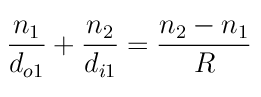
(a) Show that the equation for one refracting surface (paraxial theory) is:
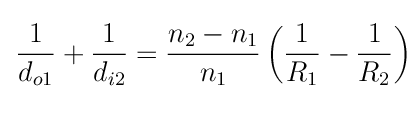
(b) Show that the equation for two refracting surfaces (paraxial theory, thin lens) is:
1. A philatelist examines the printing detail on a stamp, using a biconvex lens with a focal length of 10.0 cm as a simple magnifier. The lens is held close to the eye, and the lens-to-object distance is adjusted so that the virtual image is formed at her nearpoint of 25.0 cm. Calculate the magnification of the image.
2.What is the magnification and size of a refracting telescope that has an eyepiece with a focal length of 15 cm and an objective lens with a focal length of 75 cm?
3. A camera has a single lens with a focal length of 65.0 mm, which is to form an image on the back of the camera. Suppose the position of the lens has been adjusted to focus the image of a distant object. How far and in what direction must the lens be moved to form a sharp image of an object that is 2.00m away?
4. The magnitudes of the radii of curvature are 32.5 cm and 42.5 cm for the two faces of a biconcave lens. The glass has index 1.53 for violet light and 1.51 for red light. For a very distant object, find the locations of the violet and red light images. How do the images compare to each other in terms of location and relative size? Draw a ray diagram to illustrate.
5. How far above the horizon is the Moon when its image reflected in calm water is completely polarized? (nwater = 1.33)
6. Complete two derivations from class.
(a) Show that the equation for one
refracting surface (paraxial theory) is:
(b) Show that the equation for two refracting surfaces
(paraxial theory, thin lens) is:
Last updated September 25, 2009