The Union College Particle Accelerator

The Pelletron

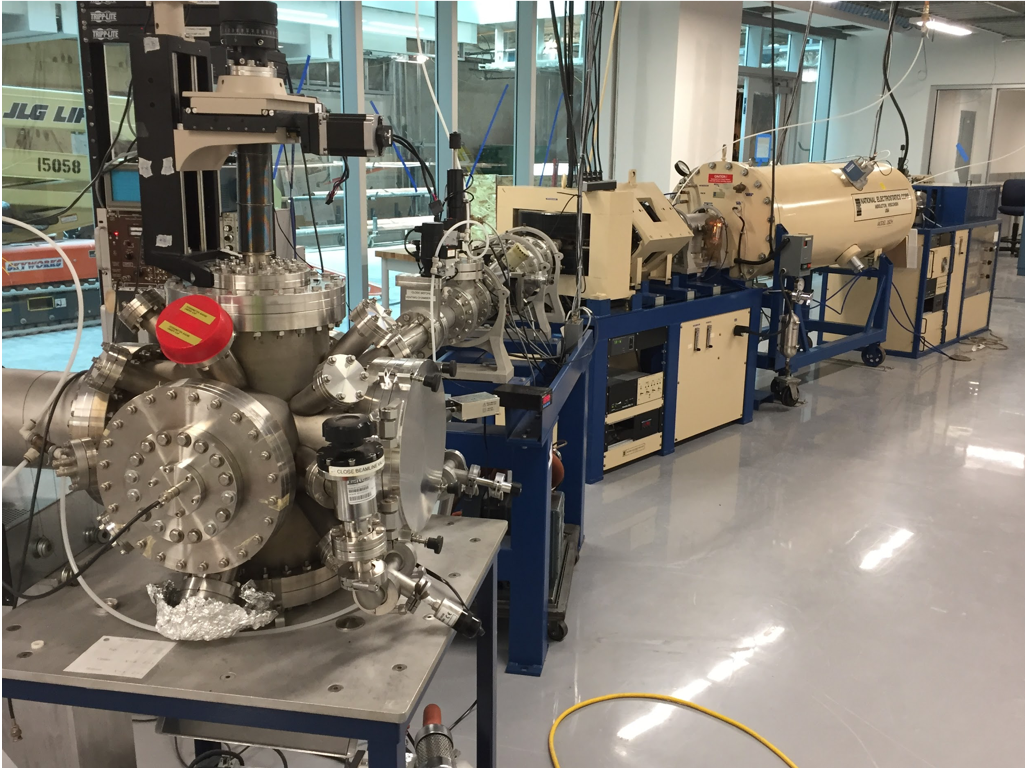
The Pelletron is a small tandem electrostatic accelerator (model 3SDH) made by the National Electrostatics Corporation.  It operates at a potential of up to 1.1 Megavolts, producing protons of with energies up to 2.2 MeV  and alpha particles with energies up to 3.3 MeV.   The on-target beams currents typically run to something between 50 and 100 nano-amps.   It has been a pretty reliable machine over the years.  Typical maintenance usually rebuilding the ion source once a year, and replacing the bearings of one of the turbo-molecular pumps (they seem to last about 18 months or so). 

The Union College Pelletron Accelerator

To see pictures of the various components of the accelerator, point your mouse over different pieces in the figure below. For a larger image, select the object by clicking the links under the pictures.

Accelerator Controler

Ion Source

Turbo and Mechanical Pumps Low Energy End

Accelerator Tank

Accelerator Tank End

Turbo & Mechanical Pumps High Energy End

Quadrapole & Steering Magnets

Analyzing Magnet and Beam Lines

Ion Pump, Beam Profile Monitor and HV Steerers

RBS Chamber

PIXE Chamber


History

Union College obtained it's first nuclear particle accelerator in about 1965 with a grant from the Atomic Energy Commission. Professors Goble, Schwarz, and Pilcher were instrumental in writing the proposal and getting the machine installed.  It was a High Voltage Engineering 400 KeV Van de Graaff machine capable of currents in excess of 100 micro-amperes.   The original purpose was to accelerate deuterons into a tritium target, and so produce 14 MeV neutrons.  The neutrons were used to study short-half life isotopes.

Professor Christopher Jones took over the machine in about 1970, and focus shifted to other uses such as PIXE (proton induced x-ray emission spectroscopy), elastic scattering, and occasionally channeling and RBS (Rutherford backscattering spectroscopy) studies.  We had a lot of fun with that accelerator over the years.  Many students did senior projects ranging from the development of auxiliary circuits to channeling to PIXE.

Recognizing the shortcomings of using 400 KeV protons (in particular for PIXE and RBS work),  the department decided in about 1990 to acquire a new accelerator.  The effort was spearheaded and the proposal was written by David Peak.  Some college funds were used to match NSF funds, and so we were successful in getting the new accelerator installed.

Applications

We have used this accelerator several ways in recent years.  We usually do one experiment in our "modern physics" course. This is often a PIXE experiment,   but we have sometime done the "Rutherford" scattering experiment in which the angular distribution of the scattered particles (protons or alpha particles) is measured.

Also, we use the accelerator for two experiments in our junior lab course, Physics 300 as well as in our freshman seminar class, Physics 100.  Physics 300 is an experimental techniques class in which the students get a hands-on introduction to both RBS and PIXE.  In addition, we have often had students doing senior projects. 

Many students elect to do senior research projects using the accelerator. In the past few years the accelerator has been host to a number of environmental physics projects.  Alyssa Maloney '05 did her senior thesis on using PIXE to analyze sediment from the Hans Groot's Kill stream that runs through the Union College campus and LLauren Carlson '07did a sophomore scholars project on the Pelletron Particle Accelerator and its application to materials analysis. Alex Kricks '07 investigated the amount of mercury that is present in seafood, particularly swordfish and shark.  Currently, Brandon Bartell '10 and Steve Po-Chedley '08 are working on projects using the accelerator.  Brandon has written VPython code to convert our spectrum data files to a format suitable for use in our analysis software, GUPIXWIN and has calibrated our accelerator using this software.  Steve is working on his senior thesis investigating the downwind radial distribution of heavy elements in the soil and in tree cores that are located near a power plant in western New York State.  In addition, Steve is working on a project in Bioremediation in which he will be analyzing samples obtained form selected areas that were ravaged by hurricane Katrina in New Orleans.

The color photograph on the right shows the scattering chamber used since 1965 for scattering experiments such as RBS studies of thin films. A Faraday cup is attached to the end line which is connected to a digital current integrator from Ortec (not shown).  When we do PIXE we replace the faraday cup with a small chamber and digital current integrator, shown in the picture on the left (the scattering chamber is covered by the dark cloth at the top). The X-ray detector is placed beneath.