Problem Set 9 - Answers
(due Wednesday, February 24)
1. Let's consider the growth of U.S. states. This spreadsheet contains data on 48 contiguous U.S. states for the following variables:
state
income per capita in 1929 in current dollars
income per capita in 1984 in current dollars
income per capita in 2004 in current dollars
a. How does the average income of the richest state compare to the average income in the poorest state in 1929?
The richest state in 1929 was New York. Its per capita income of $1,151 more than 4 times that of the poorest state, South Carolina's $267.
b. How does the average income of the richest state compare to the average income in the poorest state in 2004?
The richest state in 2004 is Connecticut. Its per capita income of $45,506 is only not even twice the $24,379 income of the poorest state, Mississippi .
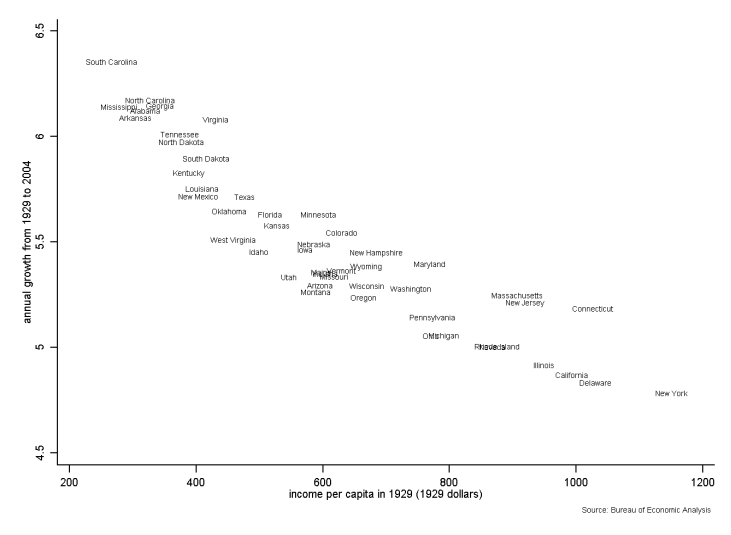
c. Produce a graph similar to graphs 10-2 through 10-4 in the textbook, with per capita income in 1929 on the horizontal axis and growth from 1929 to 2004 on the vertical axis. Is there a convergence in per capita income across U.S. states from 1929 to 2004? (Hint: You can calculate growth over the entire period as g=(Y2004-Y1929)/Y1929*100, or you can calculate annual growth as g=((Y2004/Y1929)^(1/75)-1)*100)
There is very strong convergence in per capita income among U.S. states from 1929 to 2004. States that were poor in 1929 grew substantially faster than states that were rich in 1929. Therefore, during this period the poor states were catching up with the rich states.
d. Repeat part c for the 1984 to 2004 period. Is there a convergence in per capita income across U.S. states from 1984 to 2004?
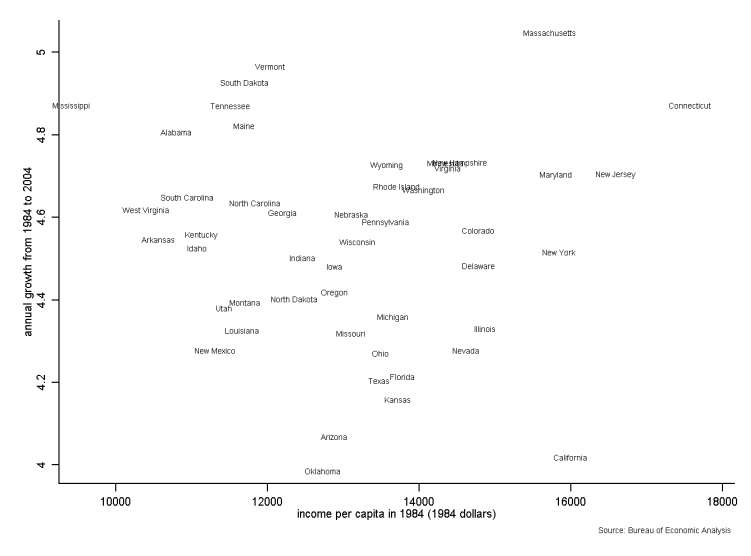
There is very little convergence in per capita incomes between 1984 and 2004. States that were relatively poor in 1984 did not seem to grow any faster than states that were rich in 1984.
e. Based on your answer to part d, would you say that the differences in the 2004 per capita income among U.S. states are growing smaller or bigger?
It appears that in the last 20 years per capita incomes in U.S. states have stopped converging. At the same time there no sign that they are diverging. Therefore, the differences grew neither smaller nor bigger.
2. Consider an economy with the aggregate production function Y=K1/3N2/3, where K is the aggregate capital stock and N is the number of workers. Answer the following questions:
a. What is the level of output when K=1000 and N=8?
Y=10001/3 *82/3=40.
b. Suppose that the aggregate capital stock grows at 3% per year and population is constant. What is the growth rate of output? (Hint: You may need to use a bit of calculus here. Send me an email or stop by if you have trouble.)
∆Y=1/3N2/3K(1/3-1)∆K
∆Y=1/3N2/3K(1/3-1+1)∆K/K
∆Y=1/3N2/3K1/3∆K/K
∆Y=1/3Y∆K/K
∆Y/Y=1/3∆K/K
If capital stock growth at 3% per year output grows only at 1% per year.
c. Does the production exhibit decreasing returns to capital?
Yes. As we saw in part c. An increase in capital by 3% results in an increase in output of only 1%.
d. Does the production function exhibit constant returns to scale?
Yes. If both factors increase by proportion x output is (xK)1/3(xN)2/3=x1/3K1/3x2/3N2/3=x(1/3+2/3)K1/3N2/3=x(K1/3N2/3)=xY, output also increases by proportion x.
e. Write the production function as a relation between output per worker and capital per worker. (Hint: Divide the production function by N.)
Y/N=K1/3N2/3/N
Y/N=K1/3N(2/3-1)
Y/N=K1/3N(-1/3)
Y/N=(K/N)1/3
f. What is the output per worker when capital per worker is 125? What happens to output per worker when capital per worker increases to 225? What happens when capital per worker increases to 325? What do your answers tell you about the relationship between capital per worker and output per worker?
When K/N=125, Y/N=5.
When K/N=225, Y/N=6.
When K/N=325, Y/N=6.9
As capital per worker increases output increases but at a decreasing rate.
g. Suppose that capital stock per worker grows at 3% per year. What is the rate of growth of output per worker?
∆(Y/N)=1/3(K/N)(1/3-1)
∆(K/N)
∆(Y/N)/(Y/N)=1/3(K/N)(1/3-1+1) ∆(K/N)/(K/N)
∆(Y/N)/(Y/N)=1/3(Y/N) ∆(K/N)/(K/N)
∆(Y/N)/(Y/N)=1/3 ∆(K/N)/(K/N)
If capital per worker grows at 3% per year, output per worker grows at 1% per year.
3. In chapter 10 we documented the vast differences in the standard of living around the world. Why do you think some countries are rich and others poor? Write your answer in one paragraph. You do not need to draw on the textbook or what we talked about in class - just tell me what you really think. By the way, here is what P.J. O’Rourke, writer for the Rolling Stone magazine, thinks as expressed in his 1999 book entitled Eat the Rich (A Treatise on Economics).
I had one fundamental question about economics: Why do some places prosper and thrive while other just suck? It’s not a matter of brains. No part of the earth (with the possible exception of Brentwood) is dumber than Beverly Hills, and the residents are wading in gravy. In Russia, meanwhile, where chess is a spectator sport, they’re boiling stones for soup. Nor can education be the reason. Fourth graders in American school system know what a condom is but aren’t sure about 9 x 7. Natural resources aren’t the answer. Africa has diamonds, gold, uranium, you name it. Scandinavia has little and is frozen besides. Maybe culture is the key, but wealthy regions such as the local mall are famous for lacking it.
Perhaps the good life’s secret lies in civilization. The Chinese had an ancient and sophisticated civilization when my relatives were hunkering in trees. (Admittedly that was last week, but they’d been drinking.) In 1000 B.C., when Europeans were barely using metal to hit each other over the head, the Zhou dynasty Chinese were casting ornate wine vessels big enough to take a bath in-something else no contemporary European had done. Yet, today, China stinks.
Government does not cause affluence. Citizens of totalitarian countries have plenty of government and nothing of anything else. And absence of government doesn’t work, either. For a million years mankind had no government at all, and everyone’s relatives were naked in trees. Plain hard work is not the source of plenty. The poorer people are, the plainer and harder is the work that they do. The better-off play golf. And technology provides no guarantee of creature comforts. The most wretched locales in the world are well-supplied with complex and up-to-date technology-in the form of weapons.
.